PHYSIO STUDY

Improving global health through universal access to physiotherapy knowledge.

October 26, 2017

Myasthenia gravis pathology | Myasthenia gravis pathogenesis

Myasthenia gravis
Myasthenia gravis is a neuromuscular disorder characterized by weakness and fatiguing of some or all muscle groups, weakness worsening on sustained exertion, or towards the end of the day, relieved by rest.

Aetiopathology
- In humans MG cause reduction of acetylcholine receptor sites in the postsynaptic folds
- Antibodies bind to the receptor sites resulting in their destruction. These antibodies are referred to as acetylcholine receptor antibodies.
- Reduced receptor synthesis and increased receptor destruction as well as well as the blocking of receptor response to acetylcholine is responsible for the disorder.
Myasthenia gravis Pathology,Myasthenia gravis defination
Myasthenia gravis
Clinical features:
Fatigue
Muscle wasting
Weakness of facial muscles
Ptosis
Nasal quality to speech
Weakness of jaw muscle – mouth remain open
Dysarthria
Dysphonia
Dysphagia
Weakness of neck muscle
Most commonly proximal muscle are affected

Sub division of clinical features:
 Class 1-          ocular muscle only
Class 2-           mild generalized weakness
 Class 3-          moderate generalized and mild to moderate ocular-bulbar weakness
Class 4-          severe generalized and ocular-bulbar 
                       weakness
Class 5-          Myasthenic crisis

Total: Class 1 (20%)
Class 2,3,4,5 (80%)

Management
Medical treatment:
 Anticholinesterase drugs 
 Steroids
 Immunosuppressants other than steroids
 Thymectomy 

Physiotherapy treatment
(a) Goals
- Myasthenia patient should find optimal balance between the physical activity and rest
- It’s not able to cure the weakness by active physical training, so low to medium intensity training is     recommended
- Enhance ability to function daily
- Decrease risk of falling
- Completion of functional tasks and maintenance of independence

(b)General exercise programs
- Should be done progressively
- Range of motion (flexibility) to light resistance to full resistance – Start with lower prescription : 3     sets of 5 reps
- The primary goal of therapy is to build the individual's strength to facilitate return to work and             activities of daily living
- Do not overdo resistive training to the point of fatigue

Type of exercise for strength are as follows :
Aerobic Exercises
Strength exercises 
Swimming
Postural exercise
Breathing exercise

(c)Postural exercise
-Important in assisting with breathing, speaking and swallowing
-Keeps bones and joints in the correct alignment so that muscles are being used properly
-Prevents fatigue because muscles are being used more efficiently, allowing the body to use less   energy

(d)Breathing exercise
- Help improve lung function
- Include inspiratory muscle training
- Pursed lip breathing
- Diaphragmatic breathing
- These exercises can improve respiratory endurance as many people with MG have affected                   respiratory muscles

(e) Exercise intensity
- The therapist has to look for the vitals after each sets of exercise
- During the time of exercise the symptoms should not be worsen
- Exercise peak dose is taking pyridostigmine

October 24, 2017

role of doctor's and physiotherapist


                                    role of doctor's and physiotherapy

                  Role of                                                                                   

-Monitoring and providing health care service to patient
-To find out the causes of the disease
-Provide medication to depress the disorder
-After injury for proper functioning of the internal system of      the   body surgeon hands play an important role 


what do physiotherapist do

         Role of

-Proper physical examination
-To prevent disability and deformity
-Educate training and transferring
-To improve tissue extensibility, increase ROM, relaxation          and  mobilize the joint the physiotherapist hand is skilled


--------------------------------------------------------------------------------------------------
So be proud of what you are and what you want to be. Your dream is your signature
-----------------------------------------------------------------------------------------------------------


October 22, 2017

ataxic gait defination | ataxic gait symptoms | ataxic gait meaning | ataxic gait causes | ataxic gait treatment

ataxic gait defination | ataxic gait symptoms | ataxic gait meaning | ataxic gait causes |ataxic gait treatment

Definition:
A loss of normal capacity to modulate fine motor movement, the patient complaint of unsteady and uncoordinated movement and lack of balance during movement it is due to cerebellar dysfunction.

The ataxic gait are of two type:

(a) Sensory gait: In ataxic gait the cerebellar are intact but the afferent fibers are     affected i.e sensory input

Sign and Symptom

-Typically the patient have lost proprioceptive and sensory input in lower limb

-They are unaware of their limb positioning

-Thus at the time of walking, they take step that are higher than necessary, while careful monitoring the ground

-Only patient with sensory ataxia slap on the floor to increase the sensory input

-And although their stance is as wide based as that of cerebellar ataxia, only sensory ataxia patients present with positive Romberg’s (swaying and falling after loss of compensatory visual input).  

(b) Cerebellar gait : This is unsteady and staggering gait towards the side of the lesion due to cerebellar lesion.

Sign and symptoms

- It is accompanied by swaying to one side or the other, so that patients often look for something to lean on – a cane, a bed rail, or even the wall.  
 -When attempting to walk tandem (heel to toe gait) it fails to maintain balance.
-Stance is also widened, but this is not enough to prevent staggering.
-Titubation while standing (fore-and-aft tremor of head and trunk) worsens considerably when patients are asked to close feet and narrow base, causing fall.
-Thus opening (or closing) the eyes neither improves nor worsens stance (negative Romberg’s)
- Hence, it differs from sensory ataxia since it is associated with other signs of cerebellar deficit, such as dysmetria , dysarthria, nystagmus, hypotonia, and intention tremor

PT management

A. provide psychological support
Give positive motivation
Gain patient confidence
Include group therapy
Explain goal and importance of exercise

B. postural correction
Use of pillows, pads to prevent abnormal posture
Use of mirror for visual feedback
Braces to correct to maintain the correct trunks

C. Sensory re-education
Use of sensory training technique like stroking, brushing and tapping
Foot splint with straps
Function stimulation

D.co-ordination and balance exercise
Non-equilibrium exercise: finger to finger exercise, finger to nose exercise, heel to shine exercise, altered pronation  /supination
Equilibrium exercise: stand with normal BOS, stand with eye open/close, stand on one leg, sit to stand, wall squatting

E. gait training
Parallel bar walking using mirror as a biofeedback
Weight shifting
Walking side way
Walking in uneven surface with support and later progress without using support

Improve heel to toe gait

October 20, 2017

waddling gait / myopathic gait / gait training / myopathic gait treatment / waddling gait treatment


waddling gait / myopathic gait
 Introduction : -
 It is a bilateral pelvic girdle weakness, typically seen in muscular dystrophy characterized by weakness of the proximal muscle of the pelvic girdle mainly the abductors of the hip.
There will be hyperextension of the trunk with shoulder thrust backward and abdomen been protuberant.

Causes

  •  Duchenne’s muscular dystrophy
  •  GB syndrome
  •  Spinal muscular atrophy
  •  OA of hip

Role of hip abductors – in waddling gait
The gluteus medius originates on the ilium (between ant. and post. gluteal lines), eventually terminating on the lateral surface of the greater trochanter.
Its contraction pulls the two insertion sites toward one another, thus elevating the opposite side of the pelvis.
 Its weakness causes contralateral sagging of the pelvis (Trendelenburg Sign)


Gait analysis
During stance phase: The weakness of proximal muscles of hip girdles, will interferes with the stability of the pelvis during walking
During swing phase: The failure to stabilize pelvis, it will produces exaggerated rotation of the pelvis with each steps
The hip are slightly flexed as a result of weakness of hip extension and there is an exaggerated lumbar lordosis.

PT Management

A. Strengthening programs

  • Active ROM to the hip joint: the movement involves hip flexion, hip extension, hip adduction, hip abduction and rotation
  • Primarily target the muscles that are responsible for gait, weakness of  muscles can lead to variety of abnormality.
  • The muscle to be strength while walking is gluteus maximus and  hamstring  for hip extension, quadriceps for knee extension, soleus &   gastrocnemius   for ankle planterflexion and dorsiflexion to step forward.
  • Progressive resisted exercise using weight cuff, theraband, resistance tube  
B. Functional balance exercise
Static exercise:      Sit to stand
                               Stand on both leg with or without support
                               Stand with eye open and close
Dynamic exercise: Straight walking
                                Tandem walking
                                Side walking      
C. Gait training

  •  Parallel bar walking by placing a mirror in front of the patient this will provide a feedback to the patient to correct the postures.
  • Make patient to walk without support
  •  During walk promote heel strike at initial contact with the floor
  • Prevent hip dropping and stabilize the pelvis

October 19, 2017

gluteus maximus gait I lurching gait


gluteus maximus gait

It is also known as lurching gait characterized by posterior leaning of the trunk at heel strike in order to keep hip extended during stance phase.


Causes

  •     Muscular atrophy
  •     Spinal muscle atrophy

Clinical features

  •     Weakness of quadriceps amd gluteus muscles
  •     Tight hamstring muscles
  •     Compensatory backward movement of trunk to maintain COG
  •     Pelvic dropping

PT Management
a. Isometric strengthening exercise of the gluteus muscles:

Ideal position: supine lying on the bed
Ask the patient to contract his buttocks and hold for 30 sec and relax.
                                         OR
The therapist hold the patient leg and passively flex hip up to 15o with hip abduction and now the patient is asked to contract the buttock.

b. Stretching of the contracted muscles like:

  •      Hamstring muscle
  •      contracted side trunk stretching
  •      Trunk ROM to maintain mobility

c. Gait training

  •     observe while walking the trunk should not lean backward
  •      Parallel bar walking by placing a mirror in front of the patient this will provide a feedback         to the patient to correct the postures. 


October 18, 2017

Choreiform Gait Physiotherapy Mx

Introduction

It is irregular, jerky, involuntary movements in both upper and lower extremities seen with certain types of basal ganglia disorder.

Clinical feature

  •         facial movement including grimaces
  •          head turning to shift eye
  •          sudden jerky movement of upper and lower extrimities
  •          unsteady gait
  •          abnormal reflex
Gait analysis

  •          it is dance like movement characterized by irregular, non repetitive or rhythmic
  •          it is wide based gait, with slow leg raising and knee flexion associated with upper limb movement
  •         this cause abnormal posture and the walking become difficult

PT management


  •         Correct the abnormal posture by positioning or by using splint: to prevent deformity
  •          Stretching of the contracted muscles: to reduce the spasticity
  •          Soft tissue and joint mobilization: to maintain the joint mobility
  •          Improve muscle tone

    Improve co-ordination and balance

a.  Non – Equilibrium exercise: - finger to nose
                                                           -finger to finger
                                                           -alternative pronation/supination
                                                           -tapping of foot
                                                           -heel to shine
         
          b. Equilibrium exercise : - standing with normal base of support
                                                 - standing with eye open / closed
                                                 - turning
                                                 - sit to stand

-         Gait and balance training

a.  Parallel bar walking using mirror as a biofeedback
b.  Weight shifting
c.   Walking side way

d.  Walking in uneven surface with support and later progress without using support


October 17, 2017

scissoring gait physiotherapy management


scissoring gait

This type of gait abnormality is associated with spastic type of cerebral palsy or upper motor neuron lesion.

Features of the following gait:


  •  it is a progressive contractures of all the spastic muscle
  •  causing rigidity and excessive adduction of the leg in swing   phase
  •  in which hip will be adducted and internally rotated
  •  knee in flexion
  •  and ankle at plantar flexion
  •  thus a complicated assisting movement of the upper limb is seen during walking
  •  inward pointed toe while walking

Gait analysis


  •  due to contracture of muscles at hip, knee and ankle it will result in excessive adduction and crossing of leg in scissor manner may touch while walking
  • subject walks on toes because of spasticity of tendoachilis
  • during walk to maintain balance they try to lift the arms and hands outwards away from the body
   PT management

To improve muscle power
 Electrical stimulation
 Strengthening exercise of weak group of muscle by resisted        exercise
Strengthening of knee extensor muscle helps to improve stride length
Aquatic therapy

To prevent contractures to reduce spasticity
To reduce the flexed postures of the body the patient should be advice to lying in prone position
Encourage to sit near the corner side of hall it will reduce the spasticity of muscle and helping the child to sit in correct position
Proper relaxation positioning
Active ROM exercise of the entire joint
Gentle stretching to increase the ROM

 Gait and balance training
First make the patient to walk with support on even surface and the progress to an uneven surface
Improve the heel to toe gait pattern
Improve side stepping
Increase the BOS during walking and progress from wide to narrow BOS
It should be noticed while the leg is kept slightly apart from each other


October 16, 2017

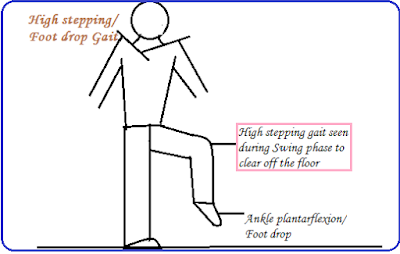
FOOT DROP / HIGH STEPPING GAIT Physiotherapy Mx


Definition

It is an abnormal neuromuscular disorder that affects the patient’s ability to raise their foot at the ankle.

Due to paralysis of the ankle dorsiflexors (tibialis anterior) the planterflexors overact causing the toes to go and first contact the ground, so to avoid this patient flex his hip and raise foot and slap on the floor forcibly.

Gait analysis

   Due to paralysis of dorsiflexors: patient cannot use dorsiflexors to attain  normal neutral position of the ankle, which is necessary to complete the task of clearing the foot during swing phase.To compensate for inability to dorsiflex the ankle by increasing the hip and knee flex above normal amount by circumduction of the entire hip or hip hiking.
-   Associated condition : GBS / Polio / Spinal disc herniation / peroneal   muscle or nerve injury / stroke

PT management


For early cases: conservative treatment can be adopted, put patient on L – splint / bandage.

Then followed by active or passive physiotherapy: Training should be first on the even surface and then on uneven surface
-               

  •              Ankle exercise to strength anterior tibialis
  •              Strengthening of calf muscle can ensure that ankle ROM is well maintained
  •              Neuromuscular electrical stimulation help in contracting muscle to have a movement and          function properly
  •             Stretching of the contracted muscle
  •            Back strengthening exercise, if there is weakness of the anterior tibialis caused by sciatica         compression
  •           Gait training by parallel bar walking using a mirror as a biofeedback
  •           Assistive device like AFO (Ankle Foot Orthosis).

high stepping gait,foot drop gait
foot drop gait


October 14, 2017

Hemiplegic Gait I circumduction gait Physiotherapy Mx

Hemiplegic Gait 

 Gait in which leg is stiff, without flexion at knee and ankle and with each steps is rotated away from the body then towards forming a semi circle.

GAIT PATTERN

The patient stands with unilateral weakness on affected side with  arm flexed, adducted and internally rotated and leg on the same side is in extented with the plantar flexion of the foot and toes on walking
In this gait patient rotates hip side way during swing phases due to hip flexors tightness and he try to place foot in flattened manner or toe strike first before heel strike. 

Clinical features

  •        affected side will be weak
  •        hyperreflexia
  •       arm and hand flexed across the body
  •       extension plantar response

Gait analysis

1. In stance phase : toe contact first instead of heel strike, the tip of toe is is maintain throughout with knee in hyperextension and hip in excessive flexion resulting the trunk to lean forward.
2. In swing phase: Toe is dragged due to insufficient dorsiflexion and limited knee flexion.Hip hiking is done to push the leg forward and trunk in extended.
3. Associated condition: Cerebrovascular Accident/ Upper Motor Lesion

Management

Medical treatment

  •       vitamin b12
  •       folate
  •       thyroid replacement
  •       calcium supplement- antidepressants 

Physiotherapy treatement

  •       Maintain the ROM necessary for normal gait
  •       anti synergic position
  •       facilitate early weight bearing 
  •       stretching for reducing spasticity
  •       strengthening exercise of anti gravity muscles to increase strength for providing stability and coordinated ambulation
  •       balance training and co-ordination training including frenkel exercise
  •       gait training using parallel bar training with visual feedback for providing opportunity to auto correction
  •       maintain trunk symmetry
  •         progress from low COG(sitting) to high COG(standing) 


October 13, 2017

parkinsonian gait | pathological gait defination | pathological gait types | pathological gait analysis | Parkinson Gait

Introduction to gait : -
It is a term used to describe the style ,manner or pattern of walking.

Gait Cycle
It is defined as all the activities that occur from heel contact of one foot to the next heel contact of the same foot.
Two gait terminologies are described:
(A) traditional terms 
 1. Stance phase  - Heel strike 
  •                     Foot flat
  •                     Mid stance
  •                     Heel off
  •                     Toe off
2. Swing phase    - Initial swing 
  •                     Mid swing
  •                    Terminal swing


B. RLA (Rancho Los Amigos) - 
  1.  Stance phase  - Initial contact 
  •                       Loading response
  •                       Mid stance
  •                      Terminal stance
  •                      Pre swing
  2. Swing Phase   - Acceleration 
  •                        Mid swing 
  •                        Deceleration

                             PATHOLOGICAL GAIT

It is an altered gait pattern due to deformities or muscle weakness
This alteration is broadly divided into : Neurological cause and musculoskeletal cause
Neurological gai t: - Parkinson gait
                                 Hemiplegic gait
                                 Ataxic gait
                                 Scissoring gait
                                 Hyperkinetic gait
Musculoskeletal :-   Tredelenburg's gait
                                Waddling gait
                                Gluteus maximus gait
                                 High stepping gait
Painful gait        :     Antalgic gait

PARKINSON GAIT :  
 Introduction : - The gait patterns is said to be shuffling gait or festinating gait The patient adopt the flexed posture of neck, trunk, hip, and knee  due to rigidity of the muscles. Because of the flexed postures the COG anteriorly and the patient try to chase the COG and to keep it in same position and regain balance, the patient tends to have the rapid shuffling gait.

causes:
The disorder is mainly due to deficiency of the dopamine in the basal ganglia circuit leading to a motor deficits. Gait is the most affected characteristic of this disorder.

This type of gait is mostly seen in:

  •        Parkinson's disease
  •       Wilson's disease
  •       Cereberal atherosclerosis


clinical features

1. Tremors: resting tremors, postural tremors, pin rolling tremors in the thumbs and the fingers.
2. Rigidity: decreases the ROM, easily fatigue, alteration in the gait pattern.
3. Bradykinesia: slowness in the movement.
4. Postural instability : Stooped posture, head protruted forward, flexion of the neck, trunk, elbow, hip and knee.

PARKINSONIAN GAIT PATTERN
  •       Festinating gait
  •       Shuffling gait
  •       Toe-heel gait
  •       Have difficulty in initiating gait
  •       Patient takes a small step on walking
  •      There is loss of heel-toe gait, as the toe strike first
  •       Loss of arm swing during walking
  •       Turning and changing direction is difficult
  •       Patient is only able to stop when he comes to contact with wall or object
  •       FOG(Freezing of gait): is typically a transient episode lasting less than a minute, in which the gait is halted and the patient complaint that his/her feet is glued to the ground.

 PT management

    Physical therapy has shown to have positive effect on gait parameters.

Improve musculoskeletal flexibility

  •       gental stretching of elbow, hip, knee and ankle flexors
  •       active ROM of the extrimities
  •       active assisted exercise of neck, trunk rotation

Balance training 

  •       it can be started from low COG position(sitting) to high COG position(standing)
  •     by pushing the patient and ask him to maintain the postures
Physiotherapists may help to improve gait by creating training programs to:
  •       lengthen a patients stride length
  •       broaden the base of support
  •       improve the heel-toe gait pattern
  •       straight out a patients posture
  •       increase arm swing patterns
  •       improving trunk flexibility, along with the strengthening of the core muscles and lower extremities has associated with the increased balanced and an improvement in gait pattern
  •       aerobic exercise such as tandem bicycling and water aerobics are also crucial in improving strength and overall balance 

Due to the progressive nature of PD's , it is important to sustain an exercise routine

  •       side walking
  •       tandem walking
  •       stair case walking
  •       reaching activities
  •      Walking in pre- marked foot print in front of the postural mirrors: to improve foot placement and widen the patient's base of support
  •       obstracle waking: to improve turning and changing direction