PHYSIO STUDY

Improving global health through universal access to physiotherapy knowledge.

Showing posts with label Pediatric. Show all posts

September 04, 2018

Clinical features in cerebral palsy|Physiotherapy management of cerebral palsy

Clinical Feature of CP

Primary : -  (due to the brain lesion)  Muscle tone (spasticity, dystonia)
                                                   Balance
                                                         Strength
                                                         Selectivity
                                                         Sensation
Secondary  :  - due to the primary impairments causing the movement disorder)
Contractures (equinus, adduction)
Deformities (scoliosis)
Tertiary : -  Adaptive mechanisms (knee hyperextension in stance)

Problems / deformities commonly seen in CP

Upper limb
Shoulder - flexion, adduction and internalrotation deformity
Elbow – flexion and pronation of forearm                                         
Wrist – flexion and ulnar deviation

Lower limb
Windswept deformity (hip joint)
Occiput side – limb in flexion, abuction and external rotation
Face side – limb in flexion, abduction and internal rotation
Knee joint
Flexion deformity
Valgus
Genu recurvatum
Ankle joint
Equinus
Valgus/ Varum deformity
Clinching of toes

MANAGEMENT OF CP

PHYSIOTHERAPY ROLE

P.T. especially when started early in life, is helpful in promoting normal motor development, and preventing deformity and contractures.

A) Medical MX
Management of Spasticity
Drugs
a. Baclofen
b. Diazepam
c. Botulinum toxin

Surgical

Tendon lengthening and transfer and arthrodesis are some of the procedures commonly performed.
Dorsal rhizotomy: which involves selective resection of posterior nerve roots from L2 to S2. It may be helpful in children with severe lower limb spasticity, with sufficient trunk control and some form of forward locomotion.

B)PhysiotherapyMX

1.Handling and positioning
2. Therapeutic exercise
- Gentle range of motion exercises
- Strengthening exercises
- Functional progressive resistance exercises
- Stretching
3.Therapeutic handling
- To influence the quality of motor response
- To use sensory information and adapt movements
4. Facilitation
- Process of intervention which uses postural tone in a goal directed activity
5. Proprioceptive neuromuscular facilitation[PNF]
PNF uses the body’s proprioceptive system to facilitate or inhibit muscle contraction. 
CP is the major the problem seen in young child, so different techniques has been and one of them is Bobath technique, roods approaches and play therapy.
Bobath technique is used to improve neuromotor development.
Roods approaches for muscle tone management by inhibitory technique (Slow rolling, prolong stretch, slow stroking) and facilitatory technique(fast stroking, quick icing, joint compression/weight bearing, stretching).
Play therapy will encourage the child to move on.
As the aim of physiotherapist should be on functional activity to make the child practice it in a real life situation.

6. Assistive and adaptive devices
Angled spoons: two handled cups
Old stools and boxes: to provide support during sitting
Standing frames: are used in the stage of mobilization
Parallel bars: for gait training
Splints, Casts and Calipers: Specially designed shoes, ankle-foot orthoses (AFO) and calipers


September 03, 2018

cerebral palsy definition | cerebral palsy types

 CEREBRAL PALSY DEFINATION / TYPES OF CP ( LITTLE’S DISEASE )

Defination
It’s
1) Persistent but not unchanging disorder of movement, tone and posture
2) due to non-progressive defect / lesion of immature brain at fetal life, infancy and childhood.
Also associated with spectrum of developmental disability such as
Ø Mental retardation
Ø  Epilepsy
Ø  Visual, hearing and speech defects
Ø  Strabismus
Ø  Cognitive dysfunction
Ø  Sensory, emotional and behavioral problems
                                                         OR                                                                     
Umbrella term covering non-progressive but often changing motor impairment syndrome that may or not involve sensory deficits that are caused by a non-progressive defect , lesion or anomaly of the developing bran and that can be in part a developmental diagnosis
First described by William Little in 1862.Then it was known as Little disease.

Classification

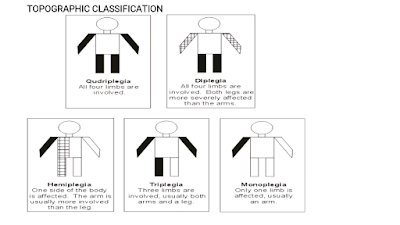
TOPOGRAPHIC

PHYSIOLOGICAL
1
MONOPLEGIA
1
SPASTIC
2
HEMIPLEGIA
2
EXTRAPYRAMIDAL
3
DIPLEGIA
3
ATAXIC
4
QUADRIPLEGIA
4
MIXED
5
DOUBLE HEMIPLEGIA
5
ATONIC
6
TRIPLEGIA
6
ATHETOID

TOPOGRAPHIC CLASSIFICATION
 
cerebral palsy definition ,cerebral palsy types
Topographic Classification of CP.
PHYSIOLOGICAL CLASSIFICATION
1) SPASTIC CP
Spasticity is defined as an velocity dependent increase in the physiological resistance of muscle to passive motion.
Result from damage to motor areas of the cerebrum; characterized by increased muscle tone, primarily of flexors and internal rotators, which might lead to permanent contractures and bone deformities.

SPASTIC DIPLEGIC
Involvement of legs more than arms often associated with premature birth. Only 11-20% are severely impaired.MR not so profound.

SPASTIC QUADRIPLEGIA
Involvement all four limbs, arms at least severely affected as leg. Severely impaired and MR. Often have bulbar symptomatology.

SPASTIC HEMIPLEGIA
Involvement of arm and leg on one side(arm > leg). Motor handicaps at least likely to be disabling. Intelligences is normal to dull.

2) ATAXIC CP
Ataxia is loss of balance, coordination, and fine motor control. Ataxic children cannot coordinate their movements. They are hypotonic during the first 2 years of life. Muscle tone becomes normal and ataxia becomes apparent toward the age of  2 to 3 years. Children who can walk have a wide-based gait and a mild intention tremor .Fine motor control is poor. Ataxia is associated when there is damage to the cerebellum (centre of balance and co-ordination).

3) ATHETOSIS CP
A condition that occurs when there is damage to the basal ganglia (masses of gray matter composed of neurons located deep within the cerebral hemispheres of the brain) results in an overflow of motor impulses to the muscles. Some characteristics of this type of CP include slow, writhing movements that are uncoordinated and involuntarily.

4) MIXED CP
Children with a mixed type of CP commonly have mild spasticity, dystonia. Ataxia may be a component of the motor dysfunction in patients in this group. Ataxia and spasticity often occur together. Spastic ataxic diplegia is a common mixed type that often is associated with hydrocephalus.

AREA AFFECTED IN CP
Site of brain injury
Pathological
Cortical
Periventricular lucomalacia   » Spastic diplegic
Sub-cortical
Stroke in utero  » Hemiplegic
Periventricular
Multifocal encephalomalacia  » Quadriplegia
Basal ganglia
Cerebellar  » ataxia
Cerebellum
Basal ganglia, thalamus, putamen  » dyskinetic
Brain stem